Why Use Agile Delivery?
Agile provides regular, structured opportunities for client and stakeholder engagement — before, during, and after each sprint. Delivering working software early and frequently builds stakeholder confidence and creates a shared understanding of progress, rather than a single reveal at the end of the project.
An Agile delivery approach gives clients continuous visibility into what has been built, what is in progress, and what is planned next. This level of transparency requires active client participation, but in return provides early warning of any misalignment between expectations and delivered output.
Fixed-duration sprints of one to four weeks produce working software increments on a regular, predictable schedule. This allows stakeholders to validate functionality early, identify priorities that have changed, and — where sufficient business value exists — release functionality ahead of the full project completion.
Because each sprint has a fixed duration and defined scope, cost and delivery pace are predictable. Combined with estimates provided before each sprint, clients can make informed decisions about feature priority and understand the approximate cost of scope changes before they are committed.
Agile allows the product backlog to be continuously refined and reprioritized between sprints, providing a controlled mechanism for incorporating changed requirements — without disrupting the current sprint or creating unpredictable cost and schedule impacts.
By allowing the client to determine feature priority, the delivery team consistently works on the functionality that delivers the most operational value. This is particularly important for enterprise projects where the business impact of prioritization decisions is significant.
Agile commonly uses user stories with business-focused acceptance criteria to define features. This keeps requirements grounded in actual user needs rather than technical specifications, and creates clear, testable conditions for acceptance at each sprint review.
By breaking delivery into structured increments and conducting testing within each sprint, quality issues are identified and resolved early — before they accumulate into the kind of late-stage rework that creates cost and schedule risk on larger projects.
Scrum Development Teams

Scrum Development Teams
At Toughlex we work in Scrum Development Teams. Scrum is a structured, lightweight framework within Agile methodology, and the most widely adopted approach for iterative software delivery. The Scrum development team is a self-organizing, cross-functional group responsible for building working software increments and meeting each sprint goal. Team responsibilities include:The development team spends the majority of each sprint on delivery — designing, building, integrating, and testing the items in the sprint backlog to produce a potentially shippable increment. The team self-organizes to plan and manage the work collectively within the sprint boundary.
The team participates in a daily scrum to inspect progress toward the sprint goal and adapt the plan for the day. This keeps the team coordinated, surfaces blockers early, and prevents unpleasant surprises at the end of the sprint.
The development team works with the product owner to refine, estimate, and prioritize upcoming backlog items — ensuring that planned work is well-understood and ready for delivery before the next sprint begins.
At the start of each sprint, the team works with the product owner to define the sprint goal and select the backlog items they can realistically deliver. This provides a clear commitment and a shared understanding of what will be produced during the sprint.
At the end of each sprint, the team demonstrates delivered functionality to stakeholders and conducts a retrospective to identify improvements to the delivery process — building a continuous improvement feedback loop into the project.
The Agile Iteration Workflow
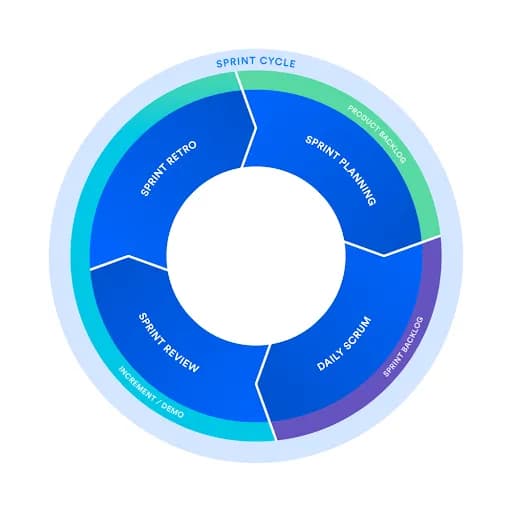
The Agile Iteration Workflow
Each sprint in an Agile delivery follows a consistent workflow. Client and stakeholder input at every stage ensures that delivered functionality meets requirements and that emerging priorities can be incorporated before the next iteration begins.A typical sprint process flow:
Define the requirements for the sprint based on the product backlog, client priorities, and feedback from the previous sprint review
Design and build software against the defined sprint requirements
Quality assurance testing, integration validation, and documentation within the sprint
Deploy the working increment to a review or production environment
Gather client and stakeholder feedback and incorporate it into the requirements backlog for the next sprint
The sprint cycle repeats for the duration of the project, working through the product backlog incrementally. This produces a continuous loop of delivery, feedback, and refinement — rather than a linear sequence that delivers value only at the end.
Scrum or Kanban?
Kanban and Scrum are both frameworks that help teams apply Agile principles in practice. Kanban emphasizes visualizing work, limiting work in progress, and optimizing throughput. Scrum uses fixed-duration sprints and defined ceremonies to create a structured delivery cadence. Toughlex typically combines elements of both — adapting the delivery process to the project's requirements and the client's operating context, rather than applying a single methodology regardless of fit.- Scrum
- Regular fixed length sprints (1-4 weeks)
- Kanban
- Continuous flow
- Scrum
- At the end of each sprint
- Kanban
- Continuous delivery
- Scrum
- Product owner, scrum master, development team
- Kanban
- No required roles
- Scrum
- Velocity
- Kanban
- Lead time, cycle time, WIP
- Scrum
- Teams should not make changes during the sprint.
- Kanban
- Change can happen at any time
Our Agile Partners
Toughlex works with experienced Agile coaches to ensure our delivery practices remain effective and current. This also enables us to help enterprise clients introduce structured Agile workflows into their own teams — improving planning, communication, and delivery predictability across multi-stakeholder initiatives.Related case studies