What is Nearshore Software Development?

What is Nearshore Software Development?
Nearshore software development means extending your team or outsourcing delivery to a partner in a neighbouring country — close enough for real-time collaboration, aligned enough for long-term engagement. Unlike offshore, nearshore eliminates the friction of time-zone gaps, communication barriers, and cultural misalignment.Lithuania runs one hour ahead of Denmark, which means the working days overlap almost completely. Combined with a shared Northern European engineering culture and the same EU regulatory framework, that makes Lithuania a natural nearshore destination for Danish businesses.
Strategic advantages of nearshoring from Lithuania
A one-hour time difference means our teams stay closely aligned throughout the day. Decisions happen faster, blockers are resolved quickly, and there's no need for the lengthy handoffs typical of offshore development.
Northern European work culture emphasises directness, accountability, and structured delivery. Lithuanian engineering teams share these values, making collaboration straightforward and predictable rather than requiring active management of communication style differences.
Lithuania is an EU member state operating under the same legal and regulatory framework as Denmark — GDPR, DORA, NIS2, and the EU Accessibility Act apply to us exactly as they apply to you. There is no offshore legal complexity, no Schrems II exposure, and no cross-border transfer problem to solve. More importantly, we have delivered inside regulated environments before: banking, insurance, and telecom, where audit trails, access control, traceability, and documented change history are delivery requirements rather than afterthoughts.
Vilnius is a two-hour flight from Copenhagen. On-site visits, team introductions, and strategic workshops are straightforward to arrange. Proximity supports the kind of high-trust, long-term cooperation that is difficult to build with distant offshore teams.
Lithuanian engineers work in English daily. Technical documentation, sprint communication, delivery reporting, and architectural discussions are conducted in English as standard — there is no language barrier to navigate or translation overhead to manage.
Why Danish businesses choose Toughlex
Denmark has one of Europe's most competitive markets for experienced software engineers, and every nearshore vendor will tell you the same thing about time zones and talent availability. The question worth asking is which partner still delivers in year three. Toughlex has been building software for regulated and operationally complex businesses since 2015, from Lithuania, with a team of around 40 people.What that looks like in practice:
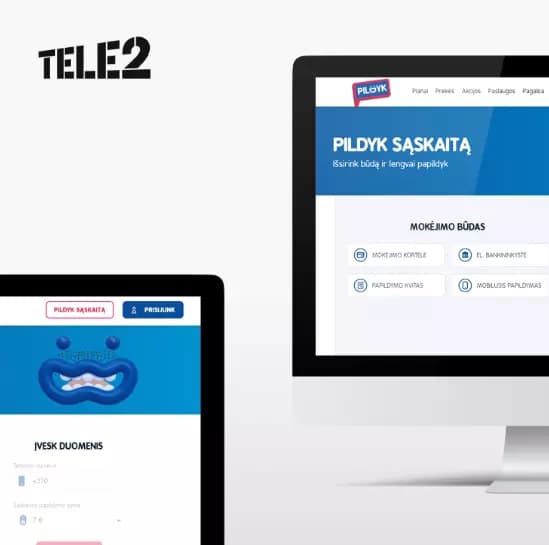
- Ten years with Tele2 — we modernised and now maintain the Pildyk prepaid self-service platform for a Nordic telecom group, at a maximum team size of 16 people, including 24/7 support for a high-traffic production service.
- Three years inside a bank — long-term delivery across internal systems, customer-facing portals, and business process digitalisation for a European bank, scaling to 28 people under compliance-aware governance.
- Engagements that last — most Toughlex cooperations run two or more years, with teams that grow as delivery demand grows rather than churning between projects.
- A commercially accountable partner — €1M professional indemnity insurance, a 4.8 review score on public platforms, and TOP Company recognition in Lithuania.
- Real team membership — a one-hour offset means our engineers join your standups, sprint planning, and retrospectives as colleagues, not as remote contractors reporting in.
When to consider nearshore development

When to consider nearshore development
Nearshore software development delivers the most value in specific contexts — where scale, speed, or specialisation exceeds what your current team can provide without a structural change.When existing platforms need structural refactoring or migration, a nearshore team with senior architectural experience can own the initiative — allowing your internal team to focus on operational continuity rather than a parallel transformation project.
The most common reason Danish companies talk to us is not that they have never nearshored — it is that the current arrangement is not working. Missed commitments, no visibility into progress, quality that degrades under pressure. Toughlex takes over existing systems and stabilises them: we inherit the codebase, document what is actually there, re-establish a delivery cadence you can plan against, and take responsibility for the outcome from that point forward.
Complex integration projects — ERP, CRM, payment infrastructure, compliance systems — require engineers who have delivered similar initiatives before. Nearshore delivery with Toughlex brings that architectural and integration experience directly to your programme.
Customer-facing portals and internal workflow automation are high-impact but resource-intensive. A structured nearshore team delivers these initiatives end-to-end, with clear quality standards and delivery accountability from requirements through to production.
Teams building AI-augmented workflows or data infrastructure need engineers who understand both the technology and the business context. Toughlex brings depth across AI integration, MCP server development, and data architecture — not just generic development capacity.
Engagement models
We structure engagements around your delivery context — not around what is easiest for us. Depending on your initiative, your existing team structure, and the level of control you want to retain, we work in four ways.A full engineering team — developers, QA, delivery lead — embedded into your product development as a long-term partner. Best suited for sustained product development where engineering continuity, institutional knowledge, and team stability are operationally critical.
Specific engineers placed within your existing team to fill capacity or skill gaps. You retain management control; we provide senior-level resources that integrate with your current structure and delivery process. Suitable for teams with governance in place that need execution capacity, not a new delivery process.
Toughlex takes ownership of the full delivery pipeline — requirements, architecture, development, QA, deployment, and long-term maintenance. Best suited for well-scoped initiatives where you want a single accountable partner rather than coordinating multiple vendors or extending an internal team.
Structured advisory engagement to define architecture direction, assess existing systems, and plan delivery before committing to a build. Appropriate for complex initiatives where getting the approach right matters as much as starting quickly — and where the cost of a wrong early decision is high.
Frequently asked questions
We are typically up to 50% cheaper than local Danish contractors, and the engineers are permanent employees rather than individuals moving between clients every few months. We work on time and materials, with every hour logged against a described piece of work — you are never asked to trust an invoice you cannot audit. Ask for an indicative rate and you will get a number, not a discovery call.
Typically two to four weeks from agreement to engineers working on your codebase, depending on the roles involved. Expect meaningful contribution in the first sprint and full velocity by the second or third — faster with documentation, slower if we are inheriting an undocumented system.
You work in our boards or we work in yours — either way you have direct access to commits, pull requests, and tickets, not a curated status report. Every piece of work is logged with hours and a description of what was done, so you can see where three hours went as easily as where eighty did. Add a sprint demo of working software and a delivery lead accountable for the commitment rather than for reporting on it. We tell you when something is at risk as we find out, not at the sprint review.
It happens, but it does not become your problem. No single point of knowledge, code review and documentation as delivery requirements, and handover overlap at our cost. We have maintained the Tele2 platform for ten years including 24/7 production support — that is not achievable if continuity depends on individuals.
Yes, and it is usually the sensible way in — a small team on a bounded initiative, before you restructure anything around a decision you have not tested. We have grown engagements to 16 people at Tele2 and 28 inside a bank, both from smaller starting teams. Scaling down works the same way.
You give notice proportional to the team size — roughly one month for two engineers, three months for six — and we hand over repositories, documentation, environment access, and knowledge transfer. That is contractual, not goodwill. The most common reason Danish companies contact us is that a previous vendor made leaving difficult; deliberate lock-in is a vendor admitting the work cannot retain a client on its merits.
You do — all source code, documentation, and deliverables are your property from the moment they are created. We retain no licence to reuse your work and embed no proprietary frameworks that require you to keep us. Third-party and open-source components are disclosed with their licences.
The first weeks are archaeology, and we treat that as a deliverable: we map what is actually running in production against what the documentation claims and give you a written assessment, including the parts you will not enjoy reading. Then we stabilise before we extend — reproducible builds, predictable deployments, critical paths under test — and only then add features. We have done this on live telecom, banking, and insurance systems where a takeover with downtime was not an option.
Lithuania is an EU member state, so GDPR, DORA, NIS2, and the EU Accessibility Act apply to us directly rather than by contractual extension — no third-country transfer, no Schrems II exposure, no standard contractual clauses to maintain. Your code and data stay in your infrastructure, engineers work against access you provision and can revoke, and we work to ISO 27001-aligned controls without being certified. We have delivered inside supervised banking, insurance, and telecom environments where audit trails and traceable change history are part of the definition of done.
Offshore development is typically located in distant time zones — India, Southeast Asia — and primarily optimises for cost reduction. Nearshore prioritises collaboration quality: same or adjacent time zone, cultural alignment, and proximity for in-person engagement when needed. For Danish businesses requiring real-time coordination, structured delivery accountability, and long-term engineering continuity, nearshore consistently delivers better outcomes than offshore despite a smaller cost differential.
Why Toughlex?
1
Full delivery pipeline: requirements, architecture, development, QA, deployment, and long-term maintenance — owned by one accountable partner.
2
Structured delivery governance: clear backlog management, sprint cadence, regular progress reporting, and early risk surfacing.
3
Senior engineering capacity: engagements are staffed with experienced engineers who take ownership of architecture and delivery quality.
4
Long-term partnership track record: most Toughlex engagements run two or more years, with teams that grow as delivery demands increase.
5
Compliance-aware cooperation: structured for regulated industries — audit trails, access controls, and documentation that meets enterprise governance requirements.
6
Transparent, accountable communication: honest estimates, clear status reporting, and no surprises on cost or timeline.
7
Professional liability coverage: €1M professional indemnity insurance, providing a credible and accountable commercial partner.
8
Proven enterprise delivery: 4.8 review score, TOP Company recognition in Lithuania, and a history of complex enterprise engagements across finance, telecom, insurance, and regulated industries.
9
European standards, international reach: a Lithuania-based team operating to European data governance requirements and enterprise operational norms, delivering for clients across the Baltics, the Nordics, Northern and Western Europe, and North America.

Projects
You want to be involved in the whole solution building process, but you expect contribution from us not in development only but in insights, ideas, project management or business development as well.
To Projects
Staff Augmentation
You want to control all aspects of your solution building process, including project management, but you don’t have enough development resources to meet your goals.
To Staff AugmentationBrands we work with




















Related case studies